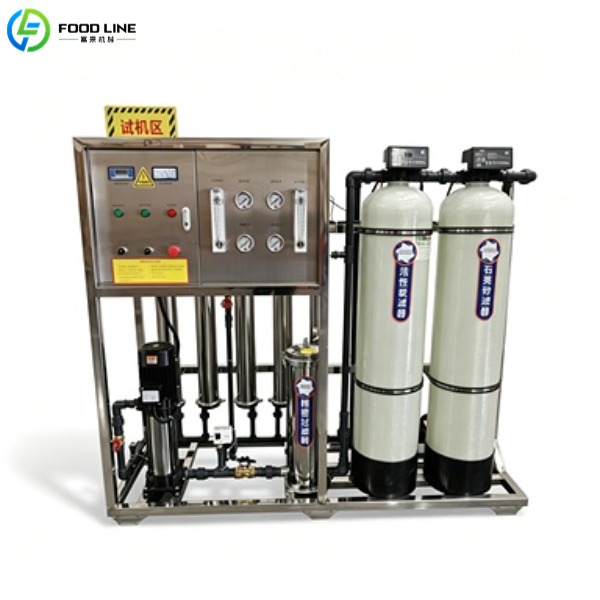
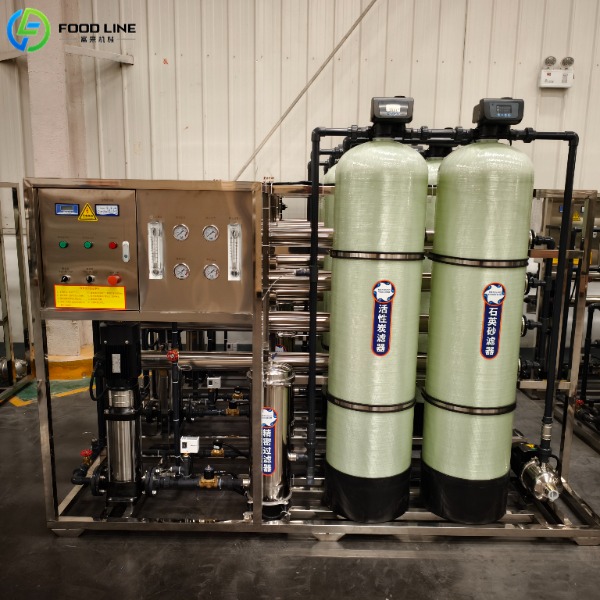
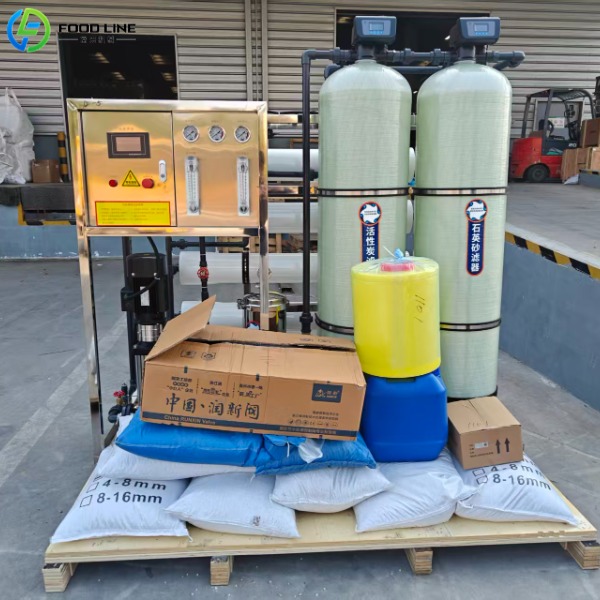
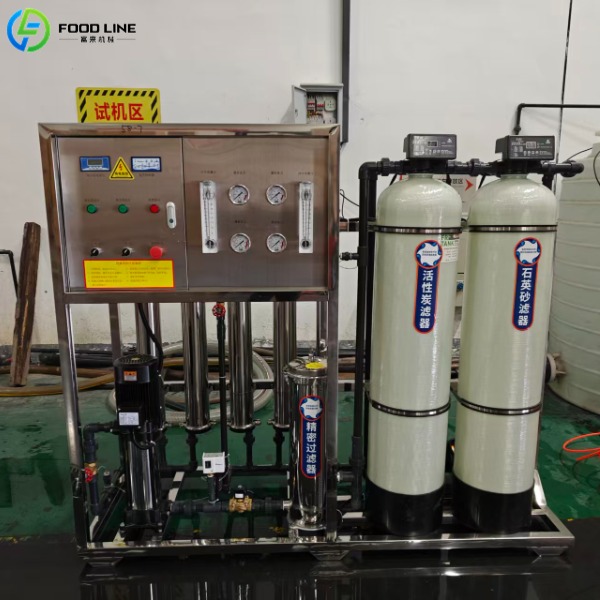
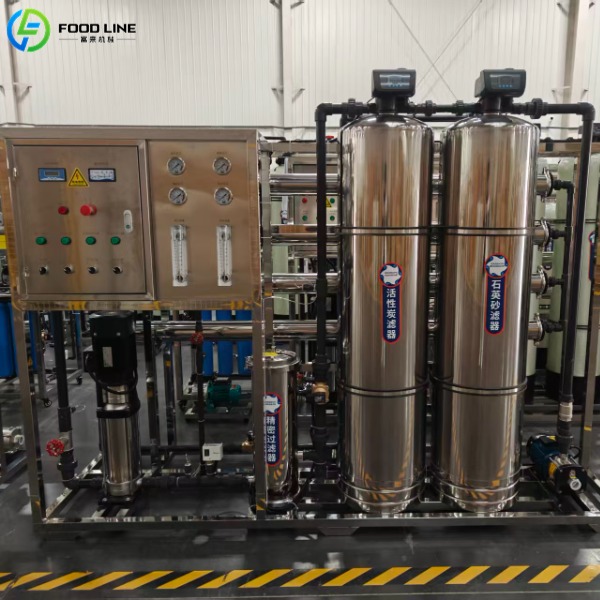
The commercial water purification system is a fully automated industrial water purification system. The entire system includes a pretreatment system, a precision filtration device, a reverse osmosis main unit, an automatic dosing system, and a terminal sterilization unit. The system is equipped with an antiscalant dosing device to effectively protect the reverse osmosis membrane, and a dual sterilization module using ultraviolet light and ozone further ensures the safety and stability of the effluent quality. The system operates automatically and features multiple pressure monitoring instruments, flow control components, and a stainless steel electrical control cabinet, making maintenance convenient and ensuring stable water production. It is widely applicable to various water usage scenarios such as drinking water production, factory production water supply, food processing, and commercial water supply.
Features of the Commercial Water Purification System
Three-stagePretreatment: The industrial water purification system features three independent pretreatment tanks: an iron and manganese removal tank, a quartz sand tank, and an activated carbon tank. Each tank has layered filter media, automatically completing filtration and backwashing processes.
Multi-dimensionalReal-timeMonitoring: The main control panel integrates pressure gauges and flow meters, enabling real-time monitoring of raw water pressure, pre-pump pressure, post-pump pressure, and concentrate pressure. It also allows for simultaneous viewing of product water and concentrate flow rates, providing visualized operational data.
StainlessSteelConstruction: The high-pressure membrane housing, precision filter housing, electrical control cabinet, and entire machine frame are all made of 304 stainless steel. This ensures corrosion resistance and suitability for humid water treatment environments.
Dual-endSterilizationStructure: The purified water output end has both an ultraviolet generator and an ozone sterilizer. These two sterilization units, operating on different principles, are integrated into the entire system and can be activated as needed for secondary sterilization of the produced pure water.
Advantages of the Commercial Water Purification System
Stable Water Quality: Multiple filtration layers intercept various impurities in the water, effectively reducing the impact of fluctuations in influent water quality, continuously producing high-purity purified water, and maintaining water quality standards over the long term.
Extended Service Life: Pretreatment removes large particulate impurities, a precision filter blocks fine suspended solids, and a scale inhibition system suppresses scaling on the membrane surface. Multiple protections reduce the probability of reverse osmosis membrane clogging and corrosion, lowering the frequency of membrane element replacement.
Saving Labor Costs: Automatic backwashing via the automatic start/stop of the main unit, and automatic high/low pressure protection eliminate the need for 24-hour on-site monitoring. Only periodic inspections and material replenishment are required, significantly reducing manual workload.
Hygienic Outgoing Water: Dual sterilization with ultraviolet light and ozone removes residual microorganisms from the water, producing pure water suitable for industrial production and commercial drinking water, broadening the equipment’s application scenarios.
Q 1: What types of water sources is this commercial water purification system suitable for?
It is suitable for different water sources such as tap water, groundwater, well water, and river water, depending on the specific configuration. Different raw water qualities require different filtration and purification solutions.
Q 2: What kind of filtration method does the commercial water filter dispenser use?
It employs a multi-stage pretreatment filtration, reverse osmosis deep filtration, and terminal sterilization and purification step-by-step filtration process, which is a water purification solution primarily based on physical filtration.
Q 3: What are the consumables for the commercial purified water machine?
The main consumables include precision filter cartridges; quartz sand and nutshell activated carbon filter media; reverse osmosis (RO) membranes; and scale inhibitors. Their replacement cycle depends on the raw water quality, frequency of use, and daily treatment volume.
With years of experience in the water treatment and purification technology field, our company has assembled a professional team of water treatment engineers who are proficient in the design and optimization of reverse osmosis water purification processes. Addressing the complex raw water qualities of different regions, we can flexibly adjust pretreatment tank configurations and filter media selections to precisely solve various water-related problems such as excessive iron and manganese in well water and high water hardness. We have successfully implemented hundreds of overseas industrial water purification projects and can provide clients with a full-chain technical service, from initial water quality analysis and equipment selection to production delivery and subsequent operation and maintenance guidance.